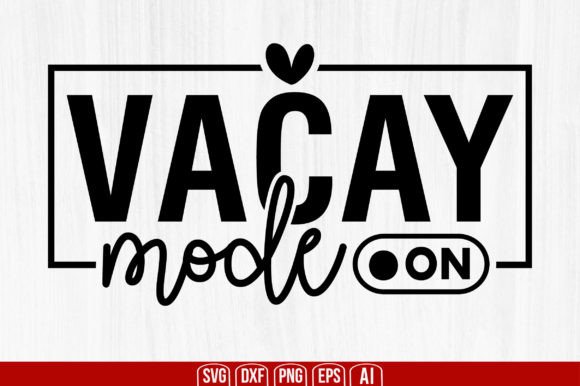
Bringing Intentional Downtime into Your Workflow with Vacay Mode On
Every professional knows the push-pull between productivity and rest. You build systems, automate tasks, and optimize every minute. Yet the moment you step away, the guilt creeps in. That is where Vacay Mode on enters the picture. It is not a calendar reminder or a passive status update. It is a deliberate visual signal that shifts your mindset and communicates boundaries to others. This digital download bundle gives you the raw assets to create that signal across any platform, device, or physical project.
The concept is simple: you toggle a state of focused disconnection. But the execution requires more than a mental note. You need assets that travel with you. The Vacay Mode on package delivers one SVG File, one PNG File, one EPS File, one DXF File, and one JPEG File. That single .zip file equips you to apply that signal anywhere—from a Cricut decal on your laptop to a banner in your email signature or a cutout on a sign for your home office door.
What Vacay Mode On Actually Does for Your Process
Think of this asset as a boundary marker. In a workflow, boundaries are not obstacles. They are decision points. When you place the Vacay Mode on graphic on a project board, a shared folder, or a physical workspace, you are telling collaborators, clients, or even your future self that this area is offline. It prevents scope creep during creative deep work, protects learning blocks, and signals to team members that responses will be delayed.
The real value lies in how it integrates with your existing tools. The included SVG and EPS files are vector formats, meaning they scale infinitely. You can embed them into a website as a temporary banner, add them to a slide deck, or import them into Adobe Illustrator or Inkscape for further customization. The PNG and JPEG offer raster options for quick drag-and-drop use in emails, social media posts, or internal chat apps. The DXF file opens the door for laser cutting or CNC routing if you want a physical sign for your studio or office.
This is not just a graphic. It is a repeatable trigger for a specific state of operation. Every time you see it, your brain associates the visual with a permission structure: no new commitments, reduced notifications, and focused recovery.
Preparation and Onboarding
Before you start a major project or creative sprint, you can deploy Vacay Mode on as a planning tool. Add the SVG to your project timeline as a placeholder for a scheduled break. Use the PNG in a team calendar invite to visually distinguish a rest block from a working session. When you are onboarding a new tool or learning a complex skill, that same graphic can mark a quiet practice period where interruptions are not allowed.
For entrepreneurs launching a product, the preparation phase often involves intense collaboration. Setting a clear Vacay Mode on zone during the final quality control check prevents last-minute feature requests from derailing the release. Print the JPEG and tape it to your workstation. Import the EPS into your task manager’s custom status field. The visual consistency reinforces the rule before the work even begins.
Active Use During a Task or Process
When you are mid-creation—editing a video, writing a chapter, or designing a layout—the temptation to context-switch is high. This is where the Vacay Mode on asset becomes a real-time governor. Drop the PNG into your screen share background during a focused work session. Set it as a temporary desktop wallpaper. If you use a Cricut or Silhouette, cut the SVG into a vinyl sticker and place it on your webcam cover or notebook cover. That physical action reinforces the mental decision to stay in the zone.
During collaborative workflows, use the DXF file to create a physical sign for a shared space. If you run a small business with a physical workshop, laser cut the design and hang it on the door. Everyone who enters sees that the space is in Vacay Mode on status. No drop-ins. No unscheduled calls. This respects your deep work and also sets clear expectations for team members who might otherwise interrupt.
In digital platforms like Adobe Photoshop, you can layer the EPS over a template to create a temporary watermark for drafts you do not want reviewed yet. It signals to clients or collaborators that the file is not final. That simple addition reduces back-and-forth emails and protects your creative process.
Post-Project Recovery and Reflection
After a major milestone—a product launch, a campaign completion, or a certification exam—the period of recovery is often overlooked. Apply Vacay Mode on to your post-mortem documents, your project archive folders, and your email autoresponder. The JPEG can serve as a signature image in your out-of-office reply. The PNG can be pinned to your Slack status. This communicates that you are in a reflection and rest phase, not available for new initiatives. It protects the quality of your retrospective work because you are not being pulled into the next cycle prematurely.
For educators and freelancers, this stage is critical. After a semester ends or a large contract finishes, the mind needs space to reset. Using the SVG to update your website’s hero section or your freelance profile banner tells potential clients that you are unavailable for new bookings until a specific date. This reduces the pressure to respond immediately and lets you decompress properly.
Practical Implementation Tips for Every Format
- SVG: Import into Cricut Design Space or Silhouette Studio for cutting vinyl, iron-on transfers, or stencils. Resize without losing quality. Use it on mugs, T-shirts, laptop skins, or wall decals.
- PNG: Drag directly into emails, chat apps, or document headers. Because this format supports transparency, you can overlay it on backgrounds without a white box.
- EPS: Open in Adobe Illustrator or Inkscape if you need to edit colors, add text, or combine it with other design elements. Ideal for professional branding applications where consistency matters.
- DXF: Load into laser cutter software or CNC machines. Great for cutting wood, acrylic, or metal signs. You can produce a durable physical object that lasts beyond a single project.
- JPEG: Use where transparency is not needed. Email signatures, social media posts, blog featured images, or printed handouts. Universal compatibility means no one struggles to open it.
Keep the original .zip file in a dedicated assets folder on your cloud storage or local drive. That way, you never dig through old downloads. Name the folder something like “Boundary Signals” or “Status Assets” so you can find it quickly when you need to toggle your mode.
How Vacay Mode On Interacts with Other Tools and Decisions
Your workflow likely involves a stack of tools: a task manager, a calendar, a design app, a communication platform, and maybe a physical workspace. The Vacay Mode on bundle sits at the intersection of all of them. It is not a piece of software. It is a design asset that you inject into those systems. That makes it format-agnostic and highly portable.
When you pair the PNG with your calendar app, you can upload it as an event attachment or embed it in the description. When you use the SVG in your design software, you can export new variants—add a date range, change the color to match a brand palette, or combine it with other icons. This composability is what makes the asset useful across different contexts. It adapts to your process instead of forcing you to adapt to it.
For teams, consistency matters. If everyone uses the same Vacay Mode on graphic across Slack statuses, email signatures, and physical door signs, the signal becomes instantly recognizable. New team members learn the cue quickly. External contractors see the same visual language across touchpoints. This reduces the cognitive load of interpreting boundaries. You do not have to explain. The graphic does the work.
From a quality control perspective, using a dedicated asset prevents ambiguity. A vague status like “out of office” or “busy” can be ignored or misinterpreted. A specific graphic that you apply consistently becomes a cultural signal. It carries more weight because it is deliberate and repeatable.
Long-Term Use and Organization
Over time, you may want to create a library of status signals: Vacay Mode on, Focus Mode, Deep Work, Do Not Disturb. The bundle you receive now can serve as the base template. Open the EPS in Illustrator, change the text, recolor the background, and save new variants. The original stays intact. This approach gives you a consistent visual system without starting from scratch each time.
For small business owners, having a cohesive set of boundary signals improves both internal efficiency and customer experience. When a client sees a Vacay Mode on banner on your site, they know orders will ship after a certain date. They do not email asking for exceptions because the message is clear. That saves you time explaining and keeps your customer service queue manageable.
Archiving is straightforward. Store each variant with a descriptive filename: vacay-mode-on-red.svg, vacay-mode-on-blue.png. If you use version control for your creative assets, treat these like any other design file. Tag them with metadata like “status,” “boundary,” or “signal.” Future you will appreciate the organization when you need to update your entire system for a new season.
The physical objects you create from the DXF file—signs, coasters, keychains—might wear over time. Re-cut them from the same file. Because the design is vector-based, the precision remains the same even years later. This longevity makes the initial download a one-time investment that keeps delivering value.
Making It a Habit
The best workflow tool is the one you actually use. To make Vacay Mode on stick, tie its deployment to a specific trigger. For example, when you close your laptop at the end of a deep work block, place the vinyl decal over your webcam. When you start a week-long break, update your website’s hero image with the JPEG. When you enter a learning phase for a new skill, set the SVG as your desktop background.
Create a simple checklist for yourself: before a vacation, swap three things—email signature image, Slack status icon, and a physical sign on your desk. That takes less than two minutes. When you return, reverse the process. Over time, this tiny ritual strengthens the boundary and makes the transition between modes smoother.
If you collaborate with others, send them the PNG file and ask them to set it as their own status when they are unavailable. This builds a shared visual language. It also signals that you respect their downtime, which encourages them to respect yours. Culture is built through repeated small actions, and a shared graphic is one of the easiest ways to start.
The Vacay Mode on digital download is not a magic switch. It is a tool. Like any tool, its value depends on how consistently you integrate it into your routine. When you do, it becomes a reliable part of your workflow that protects your attention, your rest, and your creative energy.