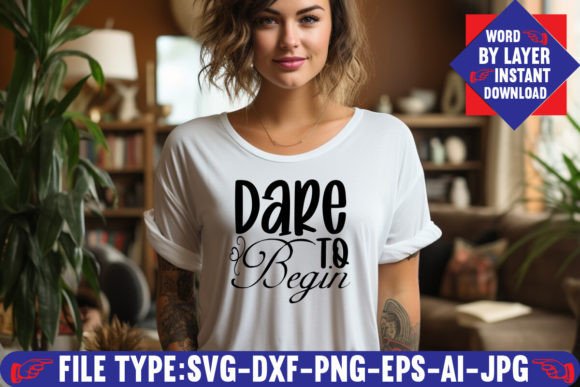
Dare to Begin Svg Design: Unlocking Creative Possibilities with Layered Vector Files
Starting a new creative project often feels like standing at the edge of a vast, open field. You have the idea, the vision, and perhaps even the materials, but something is missing. That something is often the right digital foundation. For designers, crafters, and small business owners, the difference between a stalled concept and a finished product frequently comes down to the quality and versatility of the design files you choose. This is exactly where the concept of Dare to Begin Svg Design enters the picture. It is not just a catchy phrase. It represents a practical, ready-to-use approach to creating professional-grade visuals, whether you are cutting vinyl for a custom t-shirt, layering designs for a scrapbook page, or building a brand identity from scratch.
When you purchase a digital download like this one, you are not simply buying an image. You are acquiring a toolkit. The phrase "word by layer" is essential here because it signals that the design has been constructed with depth, precision, and real-world usability in mind. Each layer corresponds to a separate component of the text or graphic, allowing you to manipulate, recolor, or rearrange elements without destroying the integrity of the overall composition. This layered structure is what makes the file adaptable across a wide range of software and cutting machines.
What You Actually Get in the Download (and Why Each File Matters)
Let’s break down exactly what arrives in that single .zip file. Understanding the purpose of each format helps you avoid frustration and ensures you pick the right tool for the job every time.
The AI File: The Master Source
Inside the download, you will find one AI file (Adobe Illustrator source file). For anyone who works professionally with vector graphics, this is the crown jewel. An AI file preserves every editable path, every anchor point, and every text element as a fully native object. If you plan to customize fonts, adjust kerning, or tweak the spacing between layers, this is the file you open. It gives you total control over the original design, which is especially valuable if you want to repurpose the layout for different products or sizes. Designers who own a Cricut or Silhouette machine often keep the AI file on hand as a backup source for generating new variations without starting from zero.
The SVG File: The Cutting Champion
The SVG file is the heart of the Dare to Begin Svg Design package. SVG stands for Scalable Vector Graphics, and it is the industry-standard format for cutting machines, web graphics, and responsive displays. Because it is vector-based, you can scale the design up to billboard size or down to a business card without any loss of quality. For crafters, this is the file you upload directly to Cricut Design Space or Silhouette Studio. The "word by layer" structure means that each color or element of the text is separated, so your machine knows exactly where to cut and where to leave space. You can assign different colors to different layers, making the assembly process intuitive even for beginners.
The PNG File: Instant Preview and Web Use
A PNG file at 300 DPI with a transparent background is included for a very practical reason: not every workflow requires vector editing. Sometimes you just need a clean, high-resolution image to drop into a mockup, share on social media, or use as a preview for customers. The transparent background means you can place the design over any photo, gradient, or solid color without ugly white boxes. At 300 DPI, the print quality is suitable for small-format prints like stickers, card fronts, or iron-on transfers. It also serves as an immediate visual reference for what the finished layered design should look like.
The EPS File: Universal Vector Compatibility
The EPS file (Encapsulated PostScript) is often overlooked by hobbyists but is a lifesaver in professional environments. EPS files can be opened in nearly any vector-editing application, including older versions of Adobe software, CorelDRAW, and even some open-source programs. If you ever switch computers or need to share files with a collaborator who uses different software, the EPS format acts as a universal bridge. It maintains vector integrity while offering broad compatibility.
The DXF File: The Engineering Standard
The DXF file (Drawing Exchange Format) might sound technical, and it is. Originally developed by Autodesk for CAD software, DXF files are widely supported by cutting machines, laser engravers, and CNC routers. If you are working with a professional-grade cutter or a maker space with specialized equipment, this format ensures your design loads correctly. It is particularly useful for those who want to scale the design for larger projects, such as wall decals or metal signs, where precision matters.
The JPEG File: A Simple Reference
Rounding out the package is a JPEG file. While it lacks transparency, the JPEG serves as a quick, universally viewable reference. You can open it on any device, attach it to an email, or use it as a placeholder in a document. It is the most accessible format in the set and ensures that even recipients without design software can see what the final product looks like.
How This Fits into Modern Crafting and Design Workflows
The modern creative workflow is rarely linear. You might start brainstorming on a tablet, move to a desktop for editing, then send the file to a cutting machine, and finally assemble the physical product by hand. The Dare to Begin Svg Design package is built to accommodate that entire journey without forcing you to convert files or redraw elements. For example, consider a small business owner who sells layered vinyl decals on Etsy. They can open the AI file to tweak the size or add a custom name, export a new SVG for the cutting machine, and use the PNG to create a listing image. Everything matches perfectly because the vector origins are consistent.
Hobbyists who enjoy scrapbooking or card making will appreciate that the layered SVG files allow for easy color swapping. If the original design uses dark blue for the base layer and light blue for the top layer, you can change both to match your paper stash or a specific theme. This flexibility reduces waste and encourages experimentation. You are not locked into the original color scheme the designer chose.
In educational settings, these files are also valuable. Teachers and students can use them to learn vector editing principles without building complex designs from scratch. Opening a well-organized, layered SVG file in Inkscape or Adobe Illustrator provides a real-world example of how paths, fills, and strokes work together. It is a hands-on learning tool disguised as a craft supply.
Practical Benefits You Might Not Have Considered
One of the most underappreciated aspects of a "word by layer" SVG file is the time it saves during assembly. When you cut a multi-layer design, each layer needs to be aligned perfectly on the final surface. If the file is poorly constructed, you spend minutes fiddling with registration marks or guessing where the top piece goes. In this package, the layers are designed to nest together logically. The base layer often contains alignment guides or subtle outlines that help you position the subsequent layers. This thoughtful construction is what separates a professional-grade download from a rushed one.
Another practical consideration is compatibility. The file set explicitly lists compatibility with Cricut, Silhouette, Inkscape, Adobe Photoshop, and Adobe Illustrator. That covers the vast majority of home and professional users. But beyond those names, the formats also work with Brother ScanNCut, Sure Cuts A Lot (SCAL), Make the Cut, and many other popular platforms. If you are unsure whether a new machine will accept your file, the DXF or EPS format usually saves the day.
For those concerned about storage and organization, the single .zip file approach is a small but meaningful convenience. You download everything at once, unzip it to a dedicated folder, and all six formats are ready to use. There is no need to hunt through email attachments or download links again later. The file naming is typically clear and consistent, which makes it easy to locate the exact format you need when inspiration strikes at an odd hour.
What to Consider Before You Download and Start
Before you purchase any digital design file, it is wise to check your software version. Older versions of Adobe Illustrator may not open newer AI files, though the EPS and SVG formats usually work as fallbacks. Similarly, some free SVG editors handle certain effects poorly. If you plan to use Inkscape, test with the SVG file first. It is also worth noting that while the PNG file is high resolution for its size, it may not be suitable for large-format printing beyond 8x10 inches without scaling artifacts. For wall-sized prints, always start from the vector source.
Another factor is the license. Digital downloads typically come with a personal or small commercial use license, meaning you can use the design for your own products but cannot resell the raw digital files as your own. Always review the terms provided by the seller. The Dare to Begin Svg Design concept encourages you to create, not to simply redistribute. The value lies in what you make with it, not in the files themselves.
Finally, consider your skill level. If you are brand new to SVG files, the abundance of formats might seem overwhelming at first. Start with the SVG and PNG files. Use the SVG for cutting and the PNG for inspiration. Once you feel comfortable, explore the AI file to see how the layers are structured. The design is meant to grow with you. As your skills improve, the same file set can serve more complex purposes, such as creating multicolor heat transfers, layered stencils, or even embroidered patches with an embroidery machine that reads DXF or SVG inputs.
The phrase Dare to Begin Svg Design is more than a product name. It is an invitation to stop waiting for the perfect moment and instead start with a solid, versatile foundation. Whether you are a seasoned professional who needs reliable vector files for a deadline-driven project or a weekend crafter exploring layered designs for the first time, the combination of AI, SVG, PNG, EPS, DXF, and JPEG files gives you everything you need to turn a digital concept into a physical reality. The layers are ready. The formats are tested. All that is left is for you to open the .zip and begin.