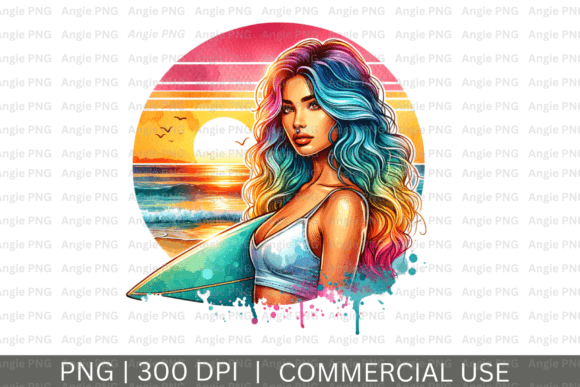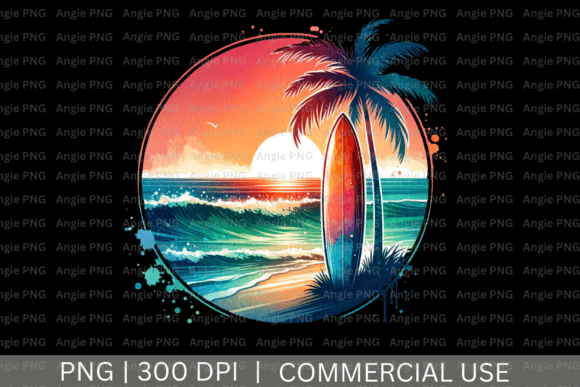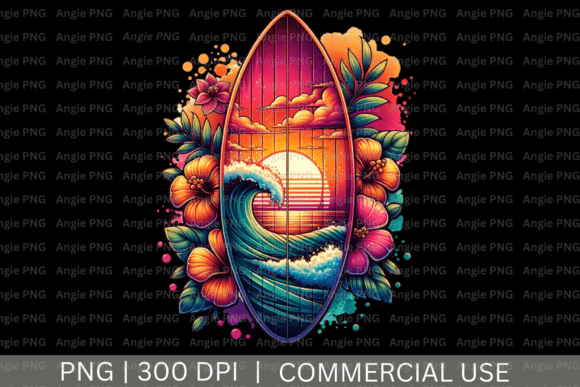
Summer Sunset Surfboard PNG Clipart
Summer Sunset Surfboard PNG Clipart captures the relaxed coastal vibe of warm evenings, golden skies, and ocean waves in a single graphic. Whether you design t-shirts, create sublimation products, or build blog visuals, this type of clipart offers flexibility and instant atmosphere. But like any digital asset, using it well requires understanding what it is, what it isn't, and where problems commonly arise.
What This Graphic Is and Why It Appeals
Summer Sunset Surfboard PNG Clipart is a ready-to-use image file with a transparent background. The scene typically features a surfboard silhouetted against a setting sun, often with palm trees, clouds, or ocean gradients. The transparent background means you can place it onto any colored surface or layered design without white boxes or awkward edges.
People gravitate toward this kind of clipart for its emotional appeal. It evokes leisure, adventure, and summer freedom. Small business owners use it for beach-themed merchandise. Bloggers drop it into travel posts. Hobbyists add it to scrapbooks or invitations. The versatility is real, but so are the pitfalls when people treat PNG files like SVG files, ignore resolution limits, or skip color checks.
Mistake One: Assuming PNG and SVG Are Interchangeable
This is the most common misunderstanding. The product description clearly states this is a PNG file, not an SVG. PNG stands for Portable Network Graphics. It stores pixel-based image data. SVG stands for Scalable Vector Graphics. It stores mathematical instructions for rendering shapes.
Why does this distinction matter? A PNG at a given resolution looks sharp only up to a certain size. If you enlarge it beyond its original dimensions, it becomes pixelated or blurry. An SVG can scale infinitely without quality loss because it recalculates the image for any size. People who expect this file to behave like an SVG are often disappointed when they try to stretch it for a large banner or a poster and end up with a fuzzy result.
How to Avoid This Mistake
Before you download or purchase, check the pixel dimensions of the PNG file. Common sizes range from 1200 x 1200 pixels to 3000 x 3000 pixels. For most t-shirt prints, card designs, or digital projects, a 2000-pixel-wide file works well. If you need a mural or a large-format print, look for vector alternatives or confirm the PNG has enough resolution for your target size. Always read the product specifications, not just the title or preview image.
If you need infinite scalability, search for vector or SVG versions of similar clipart. If you only need web graphics, small prints, or low-volume merchandise, a high-resolution PNG is perfectly fine. The key is knowing which tool fits your job.
Mistake Two: Overlooking Color Variation Between Devices and Printers
The product note warns that colors may vary between devices and printers. This is easy to ignore until you receive a batch of shirts where the sunset looks muddy orange instead of vibrant gold, or the surfboard silhouette blends into the background.
Digital screens use RGB color space. Printers typically use CMYK. When a PNG created in RGB is printed without conversion, colors shift. Bright reds become brick tones, deep blues turn purple, and sunsets lose their warmth. Even between monitors, color calibration differences cause the same file to look different on a phone, a laptop, and a design studio screen.
Practical Steps to Manage Color
- Test before production. Print a small sample on the actual material you plan to use. This is the only reliable way to see how colors behave.
- Use a color profile. If your design software supports it, convert the PNG to sRGB for web use or to a specific CMYK profile for print.
- Check brightness and contrast. Summer sunset imagery often relies on smooth gradients. Excessively high contrast on one screen might make the image look posterized on another.
- Communicate with your printer. Ask if they prefer RGB or CMYK files. Some modern printers handle RGB well, but it pays to confirm.
Color variation is not a flaw in the clipart itself. It is a normal part of working with digital images. The mistake lies in assuming what you see on your screen is what everyone else will see. A quick test saves time, money, and frustration.
Mistake Three: Ignoring Resolution and Resizing Limits
The description notes that the PNG can be resized to suit your needs. That is true, but resizing has rules. Reducing the image size is usually safe. Enlarging it beyond the original dimensions causes quality loss. Some people shrink the image for a small product like a sticker, then try to reuse the same file for a full-back print on a hoodie without re-downloading a larger version.
The result is a design that looks good in a preview at 50% zoom but falls apart at actual size. Edges that seemed smooth become jagged. Text or fine details vanish. The overall impression shifts from professional to homemade in an instant.
Better Approach to Sizing
Decide on your largest intended use first. If you plan to make both small cards and large posters, either purchase the largest file available or commit to using the PNG only for smaller formats. For large formats, consider whether a vector alternative exists. If you must enlarge a PNG, use image editing software with intelligent upscaling tools, but accept that there are limits to how much detail can be recovered.
Keep the original file backed up. Work on a copy, not the original, when resizing or editing. This lets you return to the source if you need a different size later.
Mistake Four: Neglecting Software Requirements
The product note states you need the required software and knowledge to use this graphic. This is not a plug-and-play file for every situation. A PNG with a transparent background opens in basic image viewers, but you cannot edit it without raster editing software like Photoshop, GIMP, Affinity Photo, or Procreate. You cannot change colors, remove elements, or combine it with other graphics in a word processor and expect professional results.
Beginners sometimes download a PNG and try to add it to a document in Microsoft Word or Google Docs. While this works for basic use, they often struggle with layering, resizing, or transparent background handling. The result is a design that looks off-center, misaligned, or low-resolution.
What to Check Before You Start
- Do you have access to a program that supports layers and transparency? Free options like GIMP or Canva Pro work well.
- Do you know how to insert a PNG and preserve its transparent background? In most software, you simply place or open the file, but settings like "flatten image" can erase transparency.
- Do you know how to export your final design in the correct format for your product? Sublimation printing, for example, often requires a PNG or PDF with specific color settings.
If you are new to design, spend an hour learning the basics of layers, transparency, and export settings before starting your project. Many online tutorials cover exactly this. The investment in learning prevents wasted materials and disappointing results.
Mistake Five: Overlooking License and Usage Terms
Not all clipart is free to use commercially. Even paid files may restrict how many products you can produce, whether you can sell digital items, or whether you need to credit the artist. Summer Sunset Surfboard PNG Clipart from different sellers carries different terms. Some allow unlimited commercial use. Others limit you to 500 printed items or require attribution.
Entrepreneurs and small business owners sometimes assume that buying a file gives them full ownership. That is not always true. Ownership stays with the creator unless explicitly transferred. You typically purchase a license to use the graphic under specific conditions.
How to Stay Safe
Read the license agreement before you buy. Look for keywords like "commercial use," "personal use only," "attribution required," or "unlimited." If the terms are unclear, message the seller. Keep a copy of the license in your project files. If you ever need to prove your right to use the graphic, you will have the documentation ready.
For products you plan to sell, choose clips with clear commercial licenses. If you outsource production to a print-on-demand service, check whether they require you to own the commercial rights to the designs you upload. Most do.
Mistake Six: Using Low-Resolution Previews for Final Products
Sellers often provide a preview image with watermarks or lower resolution. Some buyers try to download that preview and use it directly, hoping the quality is good enough. It almost never is. The preview is for evaluation only. The actual product file is the high-resolution PNG you receive after purchase.
Using a preview image leads to blurry prints, pixelation, and a look that tells customers you cut corners. For digital products like blog headers or social media graphics, the quality difference might not be obvious on a small screen, but for physical products, it is glaring.
Always download the full-resolution file. Store it in a dedicated folder. Use it exclusively. If you lose the original, contact the seller for a re-download link before grabbing a preview as a shortcut.
Putting It All Together: Smart Use of Summer Sunset Surfboard PNG Clipart
This graphic is a solid choice for anyone creating summer-themed products, content, or decor. Its transparent background saves time compared to cutting out a non-transparent image. The sunset and surfboard theme appeals to a wide audience, from beach lovers to fashion shoppers.
To get the best results, treat the file with the same care you would any raw material. Understand its format and limits. Test your colors. Check your software skills. Respect the license. And always work from the highest quality version you have.
When you avoid these common mistakes, you save time, reduce waste, and produce work that looks polished and intentional. Whether you are making t-shirts for a pop-up shop, designing invitations for a summer party, or building a blog post about coastal living, the right approach transforms a simple clipart file into a professional asset.
Summer Sunset Surfboard PNG Clipart is a tool. How well you use it depends less on the file itself and more on the knowledge you bring to it. With the right preparation, it can be exactly the visual shortcut you need to bring a warm sunset vibe into your next project.