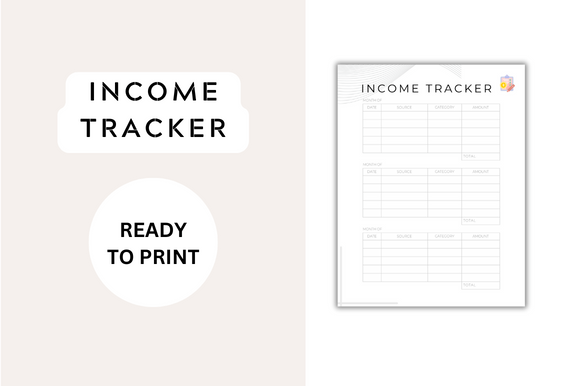
Income Tracker Printable: A Practical Tool for Financial Clarity and Creative Workflows
Tracking income is one of those tasks that feels simple in theory but often gets delayed in practice. You know you should record what comes in, when it arrives, and where it came from. But between invoices, bank notifications, and spreading sheets across multiple platforms, the actual act of logging income can become scattered. The Income Tracker Printable offers a straightforward alternative. It is a single-page printable PDF designed to sit inside your existing routine rather than demand a whole new system. What sets it apart is not just its clean layout, but the fact that after you tailor it to your needs, you can export it as an MP4 and turn it into a video invitation. That small twist transforms a practical document into something you can share, present, or use as a visual prompt.
What the Income Tracker Printable Actually Is
This is a digital product that delivers exactly one page. It comes as a printable PDF, which means you can open it on your device, edit the fields to match your categories, print it out, or keep it digital. The design is efficient: no clutter, no unnecessary sections, just space for the data that matters. You decide how to structure your entries, whether by client, project, date, or income type. Because it is a single page, it forces a certain level of discipline. You cannot hide behind endless tabs or buried spreadsheets. Everything is right there.
The PDF itself is editable, so before you commit to a printed version, you can adjust headings, add labels, or tweak the layout. Once you have it exactly as you want, you export the file in MP4 format. That export step is what turns the tracker from a static record into a moving visual. It becomes a video invitation, which opens up a surprising range of uses beyond simple tracking.
Where the Income Tracker Printable Fits in a Real Workflow
Most financial tracking happens in one of three phases: before income arrives (planning), while it is coming in (recording), or after the fact (reviewing). This printable works across all three, but its real strength lies in how it integrates with other tools and habits you already use.
Before income arrives: You can use the tracker as a forecasting sheet. List expected payments, mark them by week, and use the visual layout to anticipate cash flow. This is especially useful if you are a freelancer or small business owner juggling multiple clients. Instead of keeping mental notes, you have a single page that shows what is pending.
During recording: When payments land, you fill in the actual amounts, dates, and sources. Because the page is compact, you can keep it next to your workspace or pinned to a board. It becomes a real-time log rather than a retrospective chore. The act of writing or typing each entry takes seconds, which means you are more likely to stay consistent.
After the fact: At the end of a month or project, the completed tracker becomes a review document. You can see patterns, identify which clients pay fastest, or spot gaps in your income flow. That review informs your next round of planning. The cycle repeats.
The MP4 export adds a separate layer. Once you have your tracker configured and filled out, exporting it as a video allows you to share it as a visual summary. You can send it to a partner, accountant, or team member without handing over a raw file. It also works as a personal reminder: a short video you can replay to see your progress at a glance.
Practical Implementation Tips
Getting the most out of this printable does not require a complicated setup. Here are a few ways to integrate it smoothly into your existing routine.
Start with your categories. Before you fill in any numbers, decide how you want to group your income. Common categories include client name, project type, invoice number, payment method, or date range. If you track multiple income streams, label each row clearly. The single-page format works best when your categories are consistent over time.
Pair it with your invoicing system. If you use an invoicing tool or accounting software, the printable can serve as a quick reference sheet. Pull the key data from your invoices and log it here. That way, you have both a detailed digital record and a concise visual tracker. The printable does not replace your invoicing system; it complements it by giving you a faster overview.
Use it for project-based tracking. If you work on discrete projects or gigs, create a new version of the tracker for each one. Edit the PDF before the project starts, fill it in as payments come, and export the MP4 when the project wraps up. That video becomes a one-minute summary of your earnings for that engagement. You can keep it for your own records or share it as part of a portfolio or case study.
Keep it visible. One advantage of a single-page printable is that it demands less attention than a spreadsheet buried in a folder. Print it and place it near your desk. Write on it with a pen. The physical act of recording income can make the data feel more immediate. If you prefer digital, keep the PDF open in a dedicated tab or notes app.
Export strategically. The MP4 export is not something you need to do daily. It is most useful when you want to share a snapshot or when you have completed a cycle. For example, at the end of a quarter, export your updated tracker as a video and send it to your business partner or use it in a presentation. The video format adds a layer of polish without requiring editing skills.
How It Interacts with Other Tools and Methods
No single tool works in isolation. The Income Tracker Printable sits alongside whatever else you use to manage your finances, projects, or time. Here is how it can complement common systems.
Spreadsheets and accounting software: If you already use Excel, Google Sheets, or QuickBooks, the printable can act as a quick-look dashboard. You do not need to duplicate all your data. Just pull the high-level numbers that matter most for your weekly or monthly check-ins. The printable gives you a bird’s-eye view while your software handles the details.
Project management platforms: If you use Trello, Asana, or Notion, attach the completed printable or its MP4 export to a project card. That way, everyone on the team can see income data without digging through separate files. It works especially well for freelancers who share project updates with clients.
Calendar systems: Tie your income entries to calendar events. When you log a payment, note the date in your tracker and set a reminder for the next expected payment. Over time, you will see how your income aligns with your schedule. That awareness helps with planning downtime or busy periods.
Goal-setting frameworks: If you use SMART goals, OKRs, or simple monthly targets, the printable gives you a concrete way to measure progress. List your income target at the top of the page, then fill in actual earnings as they come. The gap between target and actual becomes immediately visible. That visual feedback can be more motivating than a number in a spreadsheet.
Collaborative workflows: When you export the tracker as an MP4, you create a file that anyone can watch. No special software required. You can include it in an email, upload it to a shared drive, or embed it in a presentation. This is particularly useful if you work with a partner or assistant who needs regular income updates but does not need to edit the original file.
Efficiency, Consistency, and Long-Term Use
The real test of any tracking tool is whether you keep using it after the first week. The Income Tracker Printable is designed to be low-friction. Because it is a single page, it does not take long to fill in. Because it is editable, you can adjust it as your needs change. And because it can become a video, it serves a purpose beyond personal record-keeping.
Efficiency: You can edit the PDF in under a minute. Filling in entries takes seconds per row. Exporting to MP4 is a single step. The entire overhead is minimal, which means you are more likely to maintain the habit. Efficiency here is not about speed for its own sake; it is about removing the barriers that cause people to abandon tracking systems.
Consistency: The key to consistent use is integration. Attach the tracker to an existing habit, such as your weekly review or your invoicing day. If you always log income right after sending an invoice, the tracker becomes part of that sequence. Over several months, the entries build into a reliable record. Consistency matters more than perfection. Even if you miss a few days, the single-page format makes it easy to catch up.
Long-term value: After a year, you will have a series of completed trackers, each representing a month or a project. Laid out side by side, they tell the story of your income over time. You can compare seasons, spot growth, and identify slow periods. That long-term perspective is hard to get from a spreadsheet that you rarely revisit. The printed or exported versions become a tangible archive.
Quality control: Because the printable is minimal, there is less room for error. Fewer fields mean fewer places to misenter data. And because you can preview the PDF before printing or exporting, you catch mistakes early. The MP4 export also forces you to look at your data one more time, which acts as a natural check.
Use Cases Across Different Contexts
While the Income Tracker Printable is clearly useful for freelancers and small business owners, its applications extend further.
For freelancers and gig workers: Track payments from multiple clients on one page. Use a new tracker each month. Export the MP4 at the end of the month to share with your accountant or to review during your personal finance check-in.
For creators and educators: If you sell courses, digital products, or memberships, log each revenue stream separately. The printable can help you see which products generate the most income at a glance. The video export works well for sharing with a co-creator or for a patreon update.
For marketers and bloggers: Track affiliate income, ad revenue, and sponsored post payments. Because the tracker is editable, you can rename columns to match your specific income types. Use the MP4 in a monthly report to stakeholders or yourself.
For hobbyists turning a passion into income: If you sell handmade goods, prints, or services on the side, the printable gives you a clear picture of your earnings without needing full accounting software. It keeps things simple while you scale up.
For small business owners with a team: Use the tracker as a quick reference during team meetings. The MP4 export can be shared with employees or partners who need a high-level view without access to your financial files.
Making It Your Own
The editable nature of the PDF is its biggest advantage. You are not locked into a rigid template. Change the title, adjust the column headers, add a note section, or remove elements you do not need. The goal is to make the tracker reflect how you actually work, not to force your work into a preset format.
Once you have made your edits, export the file as an MP4 to create your video invitation. That invite could be a personal prompt to review your finances, a shareable update for a collaborator, or even a visual asset for a presentation. The transition from printable to video is what gives this tool its unique character. It is not just a record; it is a communication tool.
The Income Tracker Printable fits into a broader process of financial organization without demanding that you overhaul your entire system. It is a single page that you can customize, print, or turn into a video. Whether you use it daily, weekly, or monthly, it serves as a focused point of reference in a world of scattered data. And that focus, over time, is what makes tracking income a sustainable habit rather than a once-a-year chore.