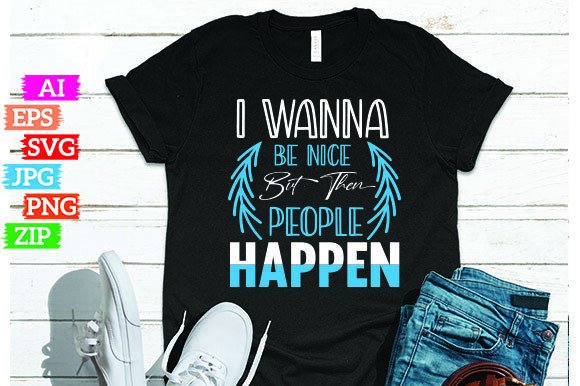
Why I Wanna Be Nice but then People Happen Is the Print on Demand Design You Need Right Now
Every print on demand seller knows the feeling. You scroll through endless catalogues of generic motivational quotes, tired nature illustrations, and overused minimalism. Then something catches your eye. A design that actually makes you smirk. A piece of wearable honesty that feels less like marketing and more like a genuine human thought. That is precisely what I Wanna Be Nice but then People Happen delivers, and it has quietly become one of the more requested motifs in the contemporary POD space. But what makes this particular design resonate so deeply, and why should you consider adding it to your product lineup? The answer lies in a combination of emotional authenticity, versatile formatting, and a production-ready workflow that removes every excuse not to launch.
The Emotional Hook That Keeps Selling
Great t-shirt design is rarely about complexity. It is about recognition. When someone reads I Wanna Be Nice but then People Happen, they do not need a backstory or a lengthy explanation. They nod. They laugh. They send a screenshot to a friend. That immediate, almost reflexive identification is the holy grail of apparel marketing. The sentiment taps into a universal experience: the constant negotiation between wanting to be kind and dealing with the reality of difficult interactions. Whether your customer works in retail, manages a team, parents teenagers, or simply navigates public transit, the line lands. It is self-deprecating without being cynical. It is honest without being aggressive. That tonal balance is rare, and it is precisely why this design translates across age groups, genders, and lifestyle niches.
From a behavioral standpoint, customers buy clothes that tell a story they already believe about themselves. The person wearing this shirt is saying, I try. I genuinely try. But sometimes the world tests that effort. That is relatable. That is shareable. And in the print on demand economy, shareability drives repeat purchases. You are not just selling fabric; you are selling a moment of solidarity between strangers who get it.
File Formats That Remove Production Friction
One of the biggest headaches for new POD sellers is receiving a design file that looks great on screen but falls apart during printing. You open the download, find a single low-resolution PNG, and suddenly you are spending hours trying to upscale, recolor, or reformat something that should have been ready from the start. That frustration disappears when you work with a properly packaged asset. The I Wanna Be Nice but then People Happen design arrives in a compressed ZIP folder containing five distinct file formats: an editable AI file, an editable SVG file, a standard PNG, an editable EPS file, and a transparent PNG printable. Each format serves a specific purpose in your workflow, and having them all at your fingertips means you never have to pause production to hunt down a converter or recreate vector paths.
Let us walk through what each format actually does for you. The editable AI file is your heavy lifter if you use Adobe Illustrator. You can tweak colors, resize elements without losing resolution, adjust kerning, or even swap out the font if your brand guidelines demand a specific typeface. The SVG file serves a similar purpose but offers broader compatibility across design tools like Inkscape, CorelDRAW, or even browser-based editors. If you work with a print provider that requires vector files for larger formats like hoodies or tote bags, SVG gives you that flexibility. The standard PNG is your quick upload option. For most direct-to-garment printers, a high-resolution PNG with proper DPI settings is all you need. The transparent PNG printable version is especially useful if you plan to layer the design over different colored backgrounds or mockups. The EPS file rounds out the set, offering a universally recognized vector format that legacy printing systems still rely on. Extraction is as simple as unzipping the folder or double-clicking to open the compressed archive. No password. No confusing folder hierarchy. Just the files you actually need.
How This Design Fits Into Modern POD Workflows
Print on demand businesses operate on speed and iteration. The faster you can test a design across multiple products, the quicker you learn what resonates with your audience. I Wanna Be Nice but then People Happen is particularly well suited for this fast-paced environment because the design works on more than just t-shirts. Consider the natural product extensions. On a cozy sweatshirt, the sentiment reads as a comfortable confession. On a tote bag, it becomes a grocery store conversation starter. On a mug, it turns morning coffee into an attitude adjustment. Because the design files include both vector and raster formats, you can resize and reposition the artwork for each product category without starting from scratch. The AI and SVG files preserve the integrity of curves and edges, so scaling the design to fit a large hoodie back print or a small hat patch remains crisp.
Many sellers make the mistake of locking themselves into a single product view. They design for a standard unisex tee and stop there. But the data consistently shows that product variety increases average order value. When a customer lands on your store and sees that same clever slogan available on a hoodie, a kids tee, a phone case, and a throw pillow, they are more likely to add multiple items to their cart. The design itself does the heavy lifting. Your job is simply to make the expansion easy, and that is where the multi-format file package becomes a practical advantage rather than just a nice bonus. You can batch-produce mockups for an entire collection in one sitting because the source files are already organized and editable.
Quality Considerations That Separate Good from Great
Not all t-shirt designs are created equal, and part of what makes I Wanna Be Nice but then People Happen stand out is the attention to visual balance. The typography is clear without being sterile. The layout leaves room for the message to breathe. Too many text-based designs cram words together until they become unreadable at a distance, but this artwork respects the relationship between negative space and legibility. When you print it on fabric, especially lighter colored garments, the transparent PNG ensures that the design integrates with the fabric rather than sitting on top of it like a sticker. That matters for customer satisfaction. Returns and negative reviews often stem from prints that feel stiff, heavy, or poorly aligned. A well-structured vector file reduces those risks because the printer receives cleaner data.
Another quality factor is color compatibility. I Wanna Be Nice but then People Happen works across a spectrum of shirt colors. On white or heather gray, the design pops with contrast. On black or navy, it carries a more grounded, almost rebellious tone. On pastel backgrounds like blush or mint, the humor feels softer and more playful. You are not limited to one color palette, and because the files are editable, you can create color variations that appeal to different segments of your audience. A version with a bright accent color might attract younger buyers, while a monochrome treatment could appeal to professionals looking for a subtle office-appropriate jab.
Who Is the Target Audience?
If you are planning your marketing strategy, the natural audience for this design is broad but definable. The primary demographic leans toward adults aged 25 to 50 who appreciate humor rooted in everyday frustration. Think teachers, healthcare workers, customer service representatives, parents, and anyone working in high-interaction environments. These are people who genuinely want to be nice but encounter enough daily friction that the phrase feels like a badge of honor. Secondary audiences include gift buyers who purchase for friends or coworkers who embody that sentiment. Birthday gifts, white elephant exchanges, and casual workplace celebrations all provide opportunities for this design to find a new home. The unisex appeal also matters. While some text-based designs skew heavily toward one gender, this message resonates equally across male and female audiences, which expands your potential market without requiring separate product lines.
Practical Recommendations for Launch
When you are ready to launch products featuring this design, start with three core products: a standard unisex t-shirt, a women's cut tee, and a pullover hoodie. Use the AI or SVG file to adjust the sizing for each product's print area. Upload the transparent PNG for colored garments and the standard PNG for white or light backgrounds. Create mockups that show the design on multiple body types and color options. In your product descriptions, lean into the humor without overexplaining. A line like some days you try your best, and some days people test that limit is enough. Let the design speak for itself. Price the items competitively within your niche, and consider bundling complementary products like a mug or sticker for an upsell. Monitor which color combinations sell best, and double down on those variants. The flexibility of having editable source files means you can respond to sales data quickly, adjusting colors or sizing without needing to commission new artwork.
Why This Design Deserves a Spot in Your Catalog
The print on demand landscape is crowded. But crowded does not mean saturated. Designs that combine humor, relatability, and high-quality production assets still stand out. I Wanna Be Nice but then People Happen checks those boxes while also respecting the seller's workflow. The ZIP folder containing AI, SVG, PNG, EPS, and transparent PNG files is not just a collection of formats; it is a signal that the design was created with real production in mind. You are not left guessing whether the resolution is sufficient or whether the colors will shift during printing. Everything is laid out for straightforward implementation. Whether you are a seasoned POD seller managing multiple stores or a newcomer launching your first collection, this design offers a low-risk, high-reward addition to your inventory. It resonates emotionally, performs technically, and scales practically. And in a business where margins depend on speed and quality, that combination is rare. It is honest design for honest sellers, and that never goes out of style.