Watercolor Beautiful Anchor Clipart: A Practical Guide for Creatives and Entrepreneurs
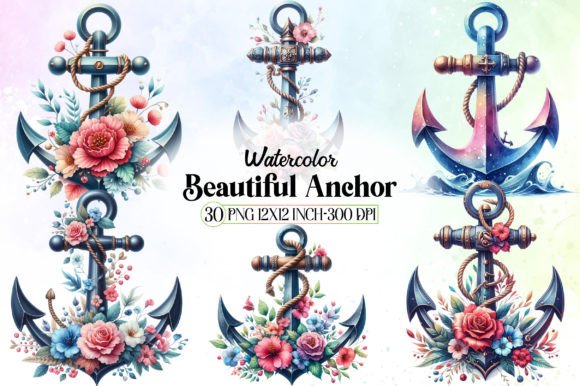
Watercolor Beautiful Anchor Clipart is a versatile design asset combining the organic, hand-painted aesthetic of watercolor with the crisp, clean edges of a nautical anchor motif. Packaged as a collection of 30 unique designs, each clipart element is delivered in PNG format at 300 dpi resolution, sized at 12×12 inches with a transparent background. The solid color distressed effect gives each anchor a textured, vintage appearance that works across multiple mediums—from apparel to home décor and digital content.
For professionals, small business owners, and hobbyists alike, this clipart set is not just a decorative element but a practical tool that slots into existing creative workflows. Whether you are a print-on-demand seller, a graphic designer handling client branding, a blogger creating visual content, or a crafter producing physical goods, understanding how to integrate these assets efficiently can save time, maintain consistency, and elevate your final output.
Where Watercolor Beautiful Anchor Clipart Fits in Your Process
Every project follows a sequence of planning, execution, and refinement. Clipart like this anchor set typically plays a role during the execution phase, but its value extends into pre-production and post-production as well. Here’s how it interacts with different stages of a typical workflow:
Pre-Production: Sourcing and Preparation
Before you start designing, you need reliable, high-resolution assets that reduce the need for manual cleanup. The 300 dpi resolution of this clipart means you can scale it up to large formats like posters or banners without pixelation. The transparent background eliminates background removal steps, saving you minutes per design. When planning a collection for a T-shirt line or a series of mugs, preview the 30 anchor variations to map out which style fits which product. This step cuts down on last-minute asset hunting.
Another practical consideration during pre-production is file organization. The PNG files come ready to use; you can rename them by color variant or distress intensity before importing them into your design software. This small habit improves efficiency when you are juggling multiple projects.
During Production: Integration with Tools and Platforms
Watercolor Beautiful Anchor Clipart is format-agnostic in practice. PNG files open natively in Adobe Photoshop, Illustrator, Affinity Designer, Canva, Procreate, and even free tools like GIMP or Photopea. Because the files are 12×12 inches at 300 dpi, they match standard print dimensions, which is particularly useful for sublimation and direct-to-garment printing. You can place the anchor onto a shirt mockup, a mug template, or a tote bag design without resizing artifacts.
The transparent background is especially important for composite work. If you are layering the anchor over a gradient background or a textured paper in a scrapbooking layout, you do not have to spend time masking edges. The distressed effect already provides a natural, uneven border that blends seamlessly with watercolor themes or vintage designs.
Post-Production: Quality Control and Consistency
After placing the clipart, check the alignment and scaling across your product line. Because all 30 designs share the same resolution and file structure, you can substitute one anchor for another without adjusting canvas sizes. This consistency is critical when maintaining a uniform look across a storefront or a brand identity. For example, if you are selling anchor-themed mugs in solid colors, you can use the same positioning template and simply swap the clipart file.
For sublimation printing, the 300 dpi resolution ensures details like the watercolor splatters and distress marks come through clearly after heat transfer. Test a few designs on different substrates (ceramic, polyester, wood) to see how the distressed effect translates. Some materials may dull the contrast; you can adjust brightness or contrast in your editing software before bulk production.
Real-World Use Cases and Workflow Examples
The beauty of this clipart set lies in its adaptability across different business models and creative pursuits. Below are several scenarios where Watercolor Beautiful Anchor Clipart can be integrated smoothly into your existing routine.
Print-on-Demand for Apparel and Accessories
If you run a print-on-demand store on platforms like Printful, Redbubble, or TeePublic, you need mockups quickly. The PNG files allow you to drag and drop the clipart onto blank shirt templates. For a coastal-themed line, select a few anchor designs with blue or teal distress effects and place them on the left chest or center front. Because the background is transparent, you can also layer the anchor over a faded nautical map or a compass rose illustration. The key is to maintain the same resolution across all layers to avoid quality loss.
For mugs, the 12×12 inch size is larger than the typical wrap area (usually 8×10 inches), so you will scale down. The high resolution means shrinking the clipart keeps its crispness. You can also export a smaller version for a mug wrap without regenerating the file. This eliminates the need to create multiple sizes from scratch.
Sublimation Projects and Custom Gifts
Sublimation involves printing onto special paper and then transferring the design to polyester-coated surfaces. The distressed effect in this clipart set works well because the uneven color edges mimic hand-painted art, which is popular for personalized gifts like pillows, coasters, and tumblers. When you receive the PNG files, you can open them in a sublimation design program like Sawgrass Print Manager or CorelDRAW. Set the color mode to CMYK if needed (the files are likely RGB by default; convert only if your printer requires it). Then, mirror the image for transfer. The transparency ensures that the anchor sits directly on the substrate without a white box around it.
One workflow tip: group multiple anchor designs on a single sublimation paper sheet to maximize material usage. Because each file is separate, you can arrange them in a grid and print them at once. This is especially useful if you are producing small batches of coasters with different anchor colors.
Digital Content and Branding
Bloggers, educators, and social media managers can use the clipart to enhance Pinterest pins, course slides, or website banners. The watercolor aesthetic adds a handcrafted feel without requiring actual painting skills. In Canva, upload the PNG files to your brand kit. You can then quickly apply them to posts, adding a consistent visual element across your feed. For a series of articles about sailing, the anchor can serve as a heading separator or a bullet point icon. The distressed effect also pairs well with serif fonts and navy color schemes, creating a cohesive brand identity.
When creating lead magnets or printable planners, insert the anchor as a watermark or decorative border. The transparent background makes it easy to adjust opacity without removing unwanted white areas. In a PDF planner, you can place a large, faint anchor behind the text for a subtle branding touch.
Practical Implementation Tips
To get the most out of Watercolor Beautiful Anchor Clipart, consider these operational factors that affect efficiency and outcome.
Preparation and File Management
- Rename files systemically: Instead of keeping generic numbers, rename each PNG by color or style (e.g., “Anchor_Blue_Distressed_01.png”). This helps when searching through 30 files later.
- Create a master template: Set up a design file in your software with your preferred canvas size (e.g., 3000×3000 pixels). Place one anchor as a smart object or linked file. Then duplicate the file for each product variation. This ensures consistent placement.
- Back up the files: Store them in a cloud folder with subfolders for “original” and “edited.” You may later create variations with different layer effects.
Compatibility and Color Accuracy
The PNG files are RGB by default, which is fine for screen use. If you are printing with a CMYK process, test a sample to see if colors shift. The distressed effect relies on subtle color gradients; you may need to convert to CMYK and manually adjust curves to preserve the watercolor look. For sublimation, use an ICC profile matching your printer and paper. Many users report that the solid color distressed designs—where the anchor appears in a single hue with varied opacity—print reliably because there are no complex blends.
For T-shirts using direct-to-garment printers, ensure the design has enough contrast against the shirt color. Light shirts work with any color; dark shirts may require a white underbase. Because the PNG has a transparent background, it is ready for manual underbase setup in software like Photoshop or Illustrator.
Organization for Long-Term Use
Treat this clipart set as a reusable asset library. Once you have used a design on a specific product, note the file name and the product SKU in a spreadsheet. If a customer reorders, you can instantly recreate the same file version without re-editing. This is particularly valuable for entrepreneurs who sell across multiple platforms and need to maintain consistency.
You can also create derivative assets from the original clips. For instance, take one anchor design and apply a different color overlay using the “Color Overlay” effect in Photoshop. This multiplies your 30 designs into 120 variations without new purchases, as long as you keep the transparent background intact.
Quality Control and Final Checks
Before sending files to production, do a quick quality check:
- Transparency check: Open the PNG in your software and zoom to the edges. There should be no fringe or white halo. If you see any, adjust the anti-aliasing or use “Select Similar” to clean up.
- Resolution verification: Confirm that the image is still at 300 dpi after scaling. In Photoshop, go to Image → Image Size and check that resolution remains 300 pixels/inch. If you scaled down significantly, you might be losing resolution; avoid scaling up beyond the original 12×12 inches.
- Mockup alignment: Place the clipart on a product mockup and check that it is centered or positioned as intended. For mugs, the design often wraps around the curve; you may need to skew the image slightly to fit the perspective.
Following for Future Assets
If you find these anchor designs useful for your workflow, following the creator for more stunning artwork ensures you have a steady pipeline of cohesive clipart. Many artists release sets in themes—nautical, floral, geometric—that share the same technical specifications (300 dpi, 12×12 inches, PNG transparent). This consistency means you can mix and match sets without reformatting. A library of such assets accelerates your design process and reduces the time spent on sourcing and prepping individual elements.
Integrating Watercolor Beautiful Anchor Clipart into your projects is a decision that pays off in saved time, reduced cleanup, and a professional finish. Whether you are a seasoned designer or a side-hustler learning the ropes, the practical approach of using ready-made, high-quality clipart allows you to focus on composition, message, and client needs rather than on digital drudgery.